

New EU thresholds and average PLN exchange rate for public procurement

12 January 2024 | Knowledge, News, The Right Focus

In accordance with the provisions of the European public procurement directives, every two years the European Commission reviews and updates the so-called EU thresholds (expressed in EUR), which determine the appropriate public procurement procedures and the value of the thresholds expressed in the currencies of those EU Member States outside of the Eurozone.

Based on a communication from the Commission, the President of the Public Procurement Office publishes an announcement in Monitor Polski, setting out the value of the current thresholds and the PLN/EUR exchange rate used to convert the value of public contracts or competitive bids. The new values are binding from 1 January 2024.

New EU thresholds and updated PLN exchange rate

In its latest announcement dated 6 December 2023, the President of the Public Procurement Office provided for an increase in the average PLN/EUR exchange rate to 4.6371 (the previous rate – effective from 1 January 2022 – was 4.4536).

The announcement also included revised EU thresholds.
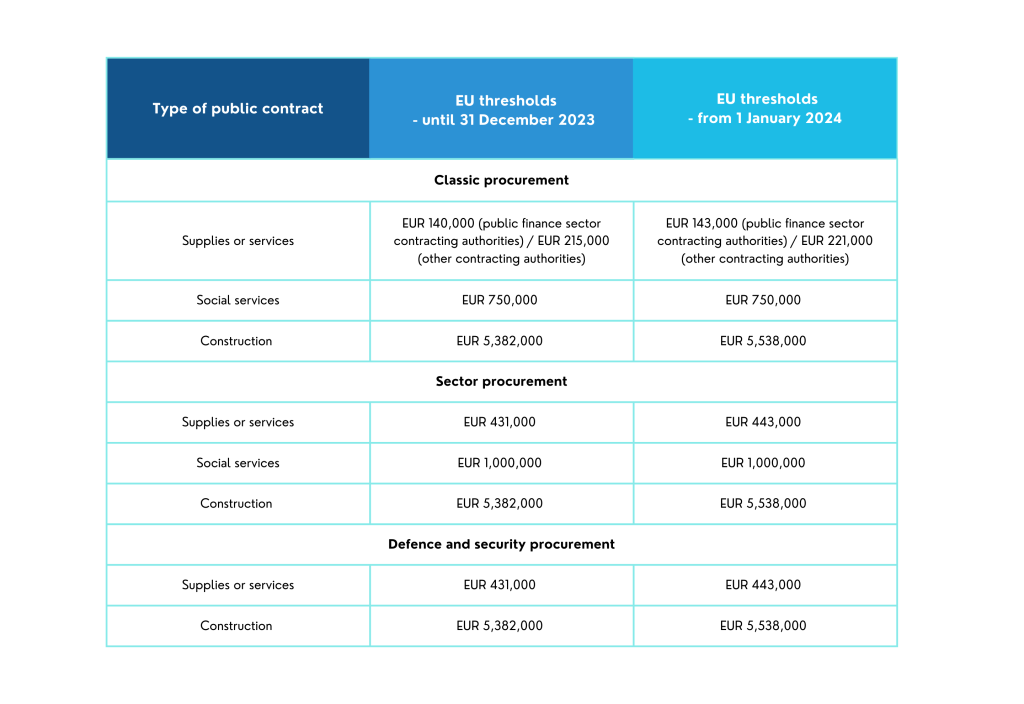
Tabelka En

Comparison of revised and previous thresholds (applicable between 1 January 2022 and 31 December 2023)

The EU thresholds have increased in the majority of cases, as shown in the table above.

How can we help with public procurement

  • Assisting in the preparation of public procurement procedures – terms of reference, public contracts
  • Analysing bids submitted in public procurement procedures
  • Representing contracting authorities before the National Appeals Chamber

Any questions? Contact us

Jakub Krysa, PhD

Michał Waraksa

Latest Knowledge

GLI – AI, Machine Learning & Big Data 2026: The Polish perspective on artificial intelligence law

Global Legal Insights (GLI) is a series of international publications by the Global Legal Group (GLG), authored by legal practitioners from around the world. It offers an up-to-date and highly practical guide to the applicable regulatory landscape, complemented by expert commentary on specific areas of law across different jurisdictions. In short: legislation and actionable know-how in one place.

Banking sector overview | Banking today and tomorrow | May 2026

“The end of the dream of free housing” – this is how the Polish Bank Association (Związek Banków Polskich) has characterised Thursday’s judgments of the Court of Justice of the European Union in cases concerning whether the claims of financial institutions against CHF mortgage borrowers have become time-barred.

Return deposits like VAT? The elephant in the room: the risks of the deposit-return system

The deposit-return system was supposed to be simple. Eco-friendly. Leak-proof. Tax-neutral. However, it took just a few months for serious doubts to emerge. The first loopholes are no longer just theoretical, they are in plain sight. The mechanisms for abuse can be described quite precisely, and the scale of potential losses may be much greater than anticipated. Below, we examine where the system is losing control and how this can be addressed.

NZIA – “Made in Europe” becomes a condition of market participation in the energy sector

The European Union has adopted a strategic course aimed at building its own production capacity in key technology sectors, including energy technologies. This policy is embodied in the Net-Zero Industry Act (NZIA), which redefines the rules of competitiveness, inter alia, in the renewable energy sector. In tenders, auctions and public support schemes, price is no longer the sole criterion for selecting a supplier. The NZIA imposes on contracting authorities and entities administering support schemes an obligation to evaluate bids also on the basis of the origin of the technology and other criteria specified in the Regulation. This change is systemic in nature and will affect all market participants – both producers and purchasers of energy technologies. In this article, I analyse how the new EU regulations will translate into business practice for companies operating in the European market.

WHT – Obligation to verify the beneficial owner status when paying dividends. An advance tax ruling by the Director of the National Revenue Administration Information Centre vs. explanations by the Minister of Finance

A Polish company paying dividends to a foreign parent company based in the EU may be exempt from withholding tax (WHT). When verifying eligibility for this exemption, is the company required to check whether the recipient of the dividend is its beneficial owner (BO)? It transpires that the Director of the National Revenue Administration Information Centre (KIS) and the Minister of Finance offer completely different answers to this question. What does this mean in practice? Let’s take a look.

Banking in 2026: technology, regulation and the new market landscape

The year 2026 will see the banking sector undergo its most dynamic transformation in a decade. The trends identified in Accenture’s Top Banking Trends FY26 report suggest that the sector is entering a phase in which technology and regulation will be inseparable, driving all aspects of change. However, it is regulation that determines the boundaries, pace and manner of implementation for new solutions. We take a look at what else the experts are focusing on.