The potential of the hemp industry in Poland

6 March 2021 | Knowledge, News

Piotr Kochanski, Senior Managing Partner and Founding Partner at Kochański & Partners, speaks to My Company Polska on hemp market developments:

“The global hemp market is one of the fastest growing sectors, with Cannabis sativa being a driving force for the economy in a number of EU Member States. It can be grown almost anywhere, regardless of climatic conditions,” says Piotr Kochański, Senior Managing Partner and Founding Partner at Kochański & Partners.

So why has the hemp industry share in the Polish economy been so marginal up to now?

Regulatory aspects are a fundamental barrier to its growth. Although Cannabis sativa is characterized by a low concentration of psychoactive THC (unlike Cannabis indica), its cultivation in Poland currently entails numerous restrictions. To grow Cannabis sativa, one needs to obtain a cultivation permit and enter into a cultivation contract. Such plantations are subject to constant inspections; failure to comply with the regulations may result in a fine or even imprisonment of up to 8 years. Strict legal regulations and ambiguity in their interpretation may lead to domestic processing being crowded out by product imports from EU Member States where the industry status has been fully regulated.”

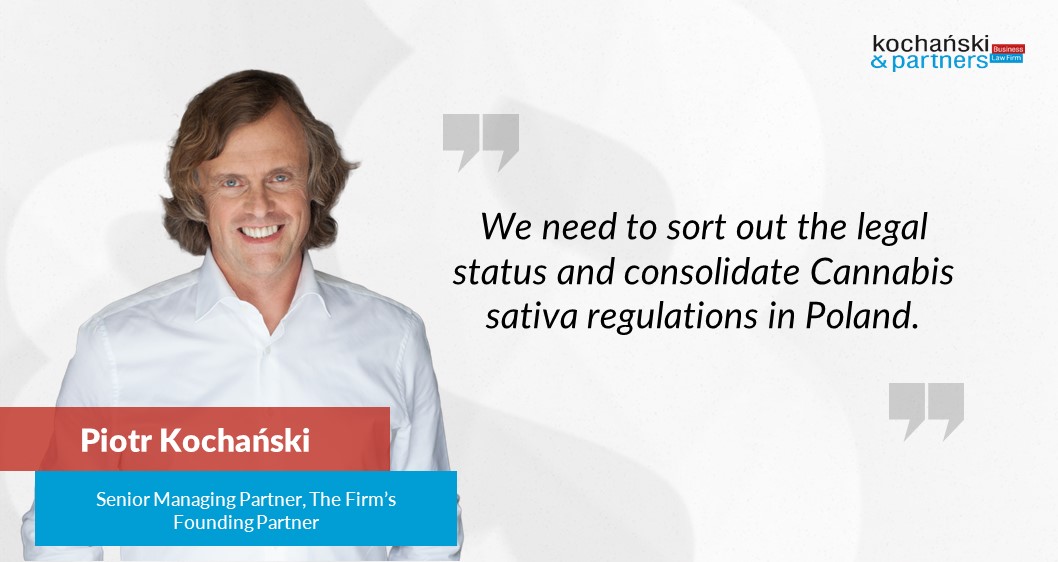
We need to sort out the legal status and consolidate Cannabis sativa regulations. The U.S. hemp boom has already reached the Warsaw Stock Exchange. Euromonitor experts forecast that the CBD market in Poland may reach PLN 5 billion by 2025. This is a considerable amount of money that domestic processors could generate for the economy, if only they were provided with a favourable regulatory environment,” stresses Piotr Kochański.

The industry has found hemp very versatile – it is inexpensive and literally the whole plant can be used for industrial purposes. Apart from traditional textile use, hemp is also used in the paper, cosmetics, pharmaceutical, chemical, automotive and construction industries and even in the power generation sector. Hemp products are also fully biodegradable and therefore environmentally friendly,” adds Piotr Kochański.

 

Latest Knowledge

Those who have data have power. The Data Act redistributes this power

The EU Data Act, which came into force in September 2025, represents a breakthrough in the regulation of data access and use. Data generated by devices, ranging from agricultural tractors and industrial machinery to solar panels and transport fleets, is no longer the sole property of manufacturers. Other market participants now have the opportunity to access and use this data to develop new, innovative products and services. The Data Act marks a departure from business models based on data monopolisation, to one requiring data to be shared in accordance with its rules. We are therefore entering a completely new reality.

KSeF and transfer pricing: a new era of transparency and operational challenges

The introduction of the National e-Invoice System (KSeF) represents one of the most significant challenges for group companies in recent years. Although the KSeF is intended to simplify the invoicing process and reduce tax abuse, it also has a significant impact on transfer pricing, particularly with regard to the documentation and settlement of TP adjustments.

Contributing assets to a family foundation – what to keep in mind

A family foundation is a legal entity whose purpose is to manage wealth effectively and ensure its succession without the risk of dispersing assets accumulated over generations. Therefore, a key issue related to the activities of such an organisation is the contribution of this wealth to the foundation in the form of various types of assets that will work for the beneficiaries. Let’s take a look at what this process involves in practice.

Cloud migration after the Data Act: new rights, lower costs and greater freedom

The Data Act requires a significant change in approach to cloud services. Companies should review their contracts and start planning updates immediately. It is crucial to introduce appropriate switching provisions and remove or renegotiate exit fees. Companies must also prepare their infrastructure, both technically and organisationally, for interoperability and migration in accordance with the new regulations.

A decade of sustainable development

Ten years ago, the international community adopted the 2030 Agenda for Sustainable Development with 17 Sustainable Development Goals (SDGs). As a signatory, Poland committed itself to implementing measures in the areas of economy, society and the environment. A decade on, and it is a good time to summarise our achievements and the key ESG regulations that have shaped the legal landscape in Poland and throughout the European Union.

Banking sector overview | Banking today and tomorrow | October 2025

According to estimates by the Polish Bank Association (ZBP), the last four months of 2025 may bring banks operating in Poland another PLN 10 billion in profits. This would set a new record, probably marking the last such good year. Forecasts for 2026 suggest that bank profits will decline to PLN 35 billion.

New tax limits for company cars

From 1 January 2026, new limits will come into force regarding the inclusion of depreciation charges and lease payments for passenger cars in tax-deductible costs.

Foreign investments in companies from strategic sectors under state protection

On 24 July 2025, amendments to the Act on the control of certain investments came into force, including the removal of the time limitation of the provisions relating to the control of certain investments prior to foreign acquisition. These regulations were introduced during the COVID-19 pandemic and were valid for a specific period.

Contact us:

Piotr Kochański

Piotr Kochański

Advocate / Senior Managing Partner / New Tech / Nuclear Energy / Media / Defence / Head of the Arbitration & Dispute Resolution Practice Group

+48 602 218 217

p.kochanski@kochanski.pl